

5 Reasons Black Americans Should Use More Free Open Source Software (FOSS)
Conversations about Black American history or the "Black dollar" oftentimes merge with the other. Slavery, segregation, redlining, eminent domain, the new Jim Crow. It's easier to rush through these topics in a short emotional conversation. Unfortunately, that oftentimes means not being able to discuss any of them in-depth. And I'm going to do that here.
This blog post is about saving money on tools that can help you make money in today's gig economy. Pro Tools, the Adobe suite, Sony Vegas, and Microsoft Windows obviously have value for their features, popularity, and job demand. But what if you don't have money for a particular paid software, especially ones with a subscription-based model? Some will say "install a pirated copy," but that's dangerous, sometimes blocked by online integrity checks, and illegal. Below are five reasons why I recommend Black Americans specifically to consider reputable free and open-source software (FOSS).
The Most Popular Free and Open Source Software You Already Use
I must address a few common misconceptions first. You likely already use free and open-source software on a regular basis: Firefox, Android, Open Broadcaster Software (OBS) for live streaming, VLC Media Player. If so, you know that free software is not inherently bad or some type of malware. To clarify, I'm not saying there isn't malicious freeware out there. I stated that not all free software is bad.
A quick list of tips to help you determine the legitimacy and quality of open source software:
- Check if it's in your operating system (OS) software repositories - Microsoft Store, Mac App Store, Linux and BSD OS repos, etc. If so, are user ratings and comments positive?
- Is it on GitHub.com? If so, are there any GitHub issues about instability or security vulnerabilities?
- When's the last time it was updated? Is it actively maintained?
- Do the developers maintain an active social media presence, YouTube, or blog for the software?
- Search for history of the software being hacked, malware, or cloned with malicious versions.
- Ask people in communities related to the app. Many graphic artists know about GIMP, though they may not use it.
- Are any reputable content creators discussing it? Are they positive, negative, mixed?
Save Money and Train More
Is open source software free? Yes, but the term "open-source" only means that the source code for the software is available. Source code is not the same as compiled code or executable files — .exe, .dmg, .AppImage, etc. Before explaining the difference, know that most open source software is free and available in ready-to-run executable format.
Compiled code is an executable file you can download and immediately run on your system.
Source code must be compiled using compiler software before you can run it. The process can be difficult for someone without command-line interface (CLI) experience, or if the software's documentation to compile from source code is inadequate, or non-existing. Open source software developers may provide only the source code to:
- Charge for convenience - pre-compiled executables, installation, and other technical support
- Avoid legal risks from being noncompliant with an open source license
- Encourage donations for continued development and maintenance fees (e.g., web hosting services)
For example, the Ardour digital audio workstation (DAW) is free and open-source. But to download the latest version, you must either:
- Pay a $1 monthly subscription or more
- Pay a one-time $45 payment
- Download a demo version that silences playback every 10 minutes
- Compile the source code yourself from GitHub
I use an older pre-compiled version provided by my Linux OS repo.
Note that the official Ardour compilation guide states they don't guarantee the steps are up-to-date, nor are they open to requests for assistance.
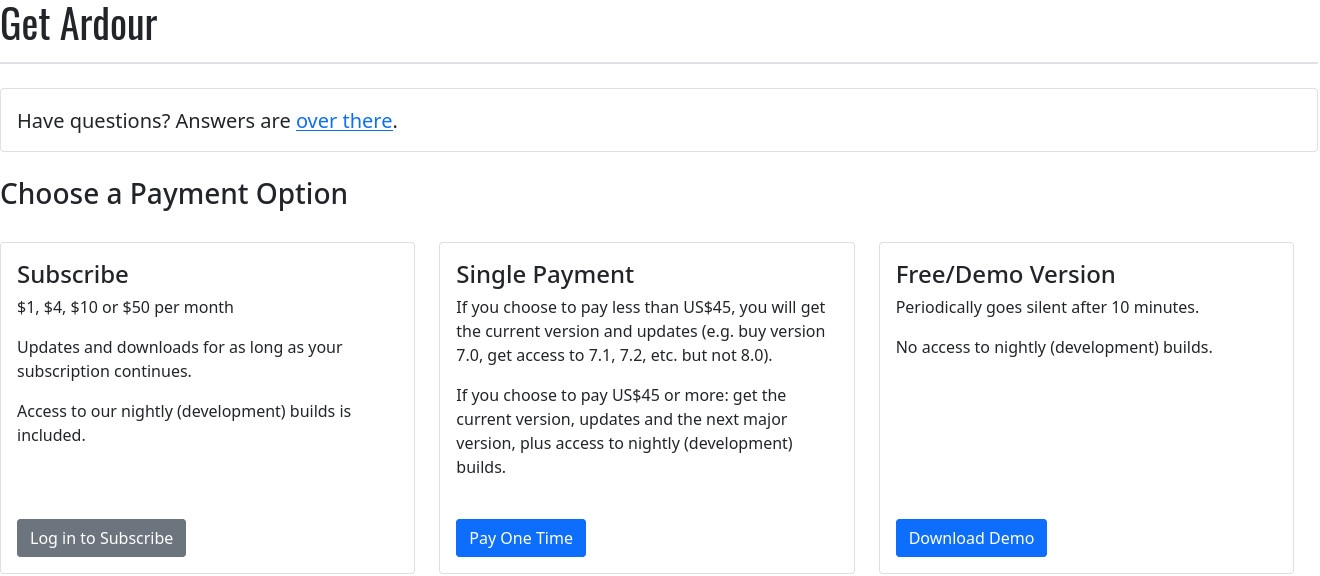
So, is Ardour free? Yes, but only if you're willing to compile the software yourself or use an older version. Again, this is an exception to the rule. It's the only free software I'll recommend in this post with this challenge.
Start Creating Now with Free and Open Source Software without Sacrificing Quality (Usually)
I've had many conversations with artists and content creators who wished they had the money to buy some proprietary commercial software to take their craft to the next level. I get it. Digital creators oftentimes prefer to hone their craft using the most in-demand tools in their respective realm. But if you don't have the money to buy, doing nothing at all isn't the answer. That's wasting time. Instead of doing nothing, that time could be better spent learning how to use free software with similar features and workflow. That way, you improve your skills while learning what could become a solid backup plan if your commercial product ever has an issue. Even better, many free alternatives can export to formats compatible with their commercial counterparts. This eases the transition once you can afford that proprietary product.
Below are some industry standard commercial applications and popular alternatives I use on my Linux OS.
All free software mentioned below work on Windows, macOS, and Linux unless stated otherwise.
FL Studio (formerly Fruity Loops) is my go-to music production tool. It's also reportedly the most commonly pirated DAW. I actually use FL on my Linux OS (with WineHQ). I use the aforementioned Ardour DAW to record and edit audio, but it can do so much more.
I use the LMMS DAW to create and mix beats. Is LMMS safe? Yes, if you download it directly from lmms.io.
I don't have a good substitute for Native Instruments Komplete or Waves Plugins, but x42-plugins suffices for me. Linux users can integrate the Carla audio plugin host to use such Windows-only tools.
I've written further in-depth about more audio editing software.
Adobe Photoshop is the most commonly pirated creative software. For the price, free, GNU Image Manipulation Program (GIMP) works well for my image editing needs. I've used GIMP to work with Photoshop projects. GIMP doesn't simplify the graphic design process with a ton of templates like Canva.com. Is GIMP safe to download? Yes, from gimp.org or official repositories.
Clip Studio Paint, the most popular app for digital drawing and painting, looks similar to what I use for free: Krita. Inkscape is good for SVG files.
For context, I'm not an experienced photographer or graphic designer. Therefore, I cannot tell you from personal experience how well these free software alternatives compare to their commercial counterparts.
Adobe Premiere Pro is a commonly pirated video editor. I've been using Kdenlive for years. Admittedly, it sometimes crashes if I do too much at a time, but auto saves, patience, and the price (free) make it more tolerable. I created a video years ago showing how to use Kdenlive. I usually recommend OpenShot Video Editor for basic video editing.
I have listicle with other free video editing software.
Microsoft Office is the standard for office productivity suites. I got through college and finished dozens of projects with LibreOffice. Is LibreOffice safe? Yes, and completely free from LibreOffice.org.
| Microsoft Office | LibreOffice | Extra Info |
|---|---|---|
| Microsoft Word | Libre Writer | N/A |
| Microsoft Excel | Libre Calc | N/A |
| Microsoft PowerPoint | Libre Impress | N/A |
| Microsoft Visio | Libre Draw | N/A |
| Microsoft Access | Libre Base | N/A |
| N/A | Libre Math | Create mathematical equations |
Adobe Acrobat PDF Editor, surprisingly a commonly pirated software, is $15+ monthly. The only justification for Acrobat that comes to mind is the need to digitally sign PDF files. I use GIMP to "sign" documents. Libre Draw, part of LibreOffice, lets you make deeper changes within the PDF file elements.
Family Tree Maker is the most popular genealogy software, partly because it syncs with Ancestry.com. RootsMagic is a close second because it's a one-time purchase. For a free alternative, check out GRAMPS.
Microsoft Windows obviously isn't free, but that's not the reason Windows makes this list. Imagine you have an old laptop from the early 2000s. It may not run the latest Windows version well. If it does, you may need to pay for a license. If you're open to learning something new, you could install a free Linux OS on it. That might sound intimidating, but it's not nearly as difficult as it sounds. I have an old guide on how to install Linux. So you don't have to research 200+ Linux OSes, I recommend starting with these two:
- Linux Mint (Cinnamon) is a great OS for users new to Linux. The user interface (UI) is similar to Windows.
- Ubuntu Studio is an OS for creators. It comes packed with dozens of free and open source software, including ones I've mentioned here preinstalled. It's good for creatives who want to be fully immersed in free software.
Below is a small table comparing some of the pirated software of all time with free alternatives.
| Commercial Software | Free Software | Another Free Option |
|---|---|---|
| Adobe Photoshop | GIMP | N/A |
| Adobe Premiere Pro | Kdenlive | OpenShot Video Editor |
| Adobe Acrobat PDF Editor | GIMP | Libre Draw |
| Clip Studio Paint | Krita | Inkscape |
| Family Tree Maker | GRAMPS | N/A |
| FL Studio | Ardour | LMMS |
| Microsoft Office | LibreOffice | N/A |
| Microsoft Windows | Linux Mint (Cinnamon) | Ubuntu Studio |
Money Spent doesn't Equal Value
I've implied this throughout this post so far, but the cost of something doesn't always correlate with its value. Value can obviously be subjective to the individual and situation. For example, if you have an issue with Photoshop, you can find tons of content about it. You can also contact technical support. That's important for creators who don't want to spend time troubleshooting. With GIMP, you'll find plenty of content, but there's no dedicated support - just forums and Internet Relay Chat (IRC) channels.
Another example, I've had a few issues with Microsoft Office files in LibreOffice in the past. But none of them were bad enough to justify installing MS Office on Linux. A college student using Windows with access to a free, official MS Office download (through the university) has no reason not to take advantage of that.
It can Encourage you to Create Something
Using free and open source software enabled me to build custom solutions to unique problems. I'm not saying you need to use open source software to be innovative. But that freedom helps me think outside the box about ways to optimize my workflow and performance. We need more Black entrepreneurs and successful Black-owned businesses. Something in this post might get the gears going.
Reparations ain't Coming Anytime Soon
Getting to the real now, pro-Black activists and reparationists are working hard. But there's still so much work to be done politically, culturally, socially, and so on. Don't be one of those people hiding behind the "I'm waiting for reparations" excuse. I'm not saying you should make some kind of Faustian bargain (deal with the devil), but find a way to work towards your goals.
That's the purpose of this post, to give you ideas to work on your craft now. Research your lineage. Learn how anti-Black racist stereotypes like the "13 50" myth affect you. Take a free financial literacy course. Try at least one of the free software mentioned in this post. You may not like it. But you likely know someone who will. Continue to grow as one, and as a community.
This is probably one of my most technical sociological blog posts. I hope the Black American / ADOS readers do something with it.
Tags: black-community, black-owned-businesses, free-open-source-software, IT, linux, money