

Black-Owned Search Engine for Black Americans: Why I Built Conscious Baseline
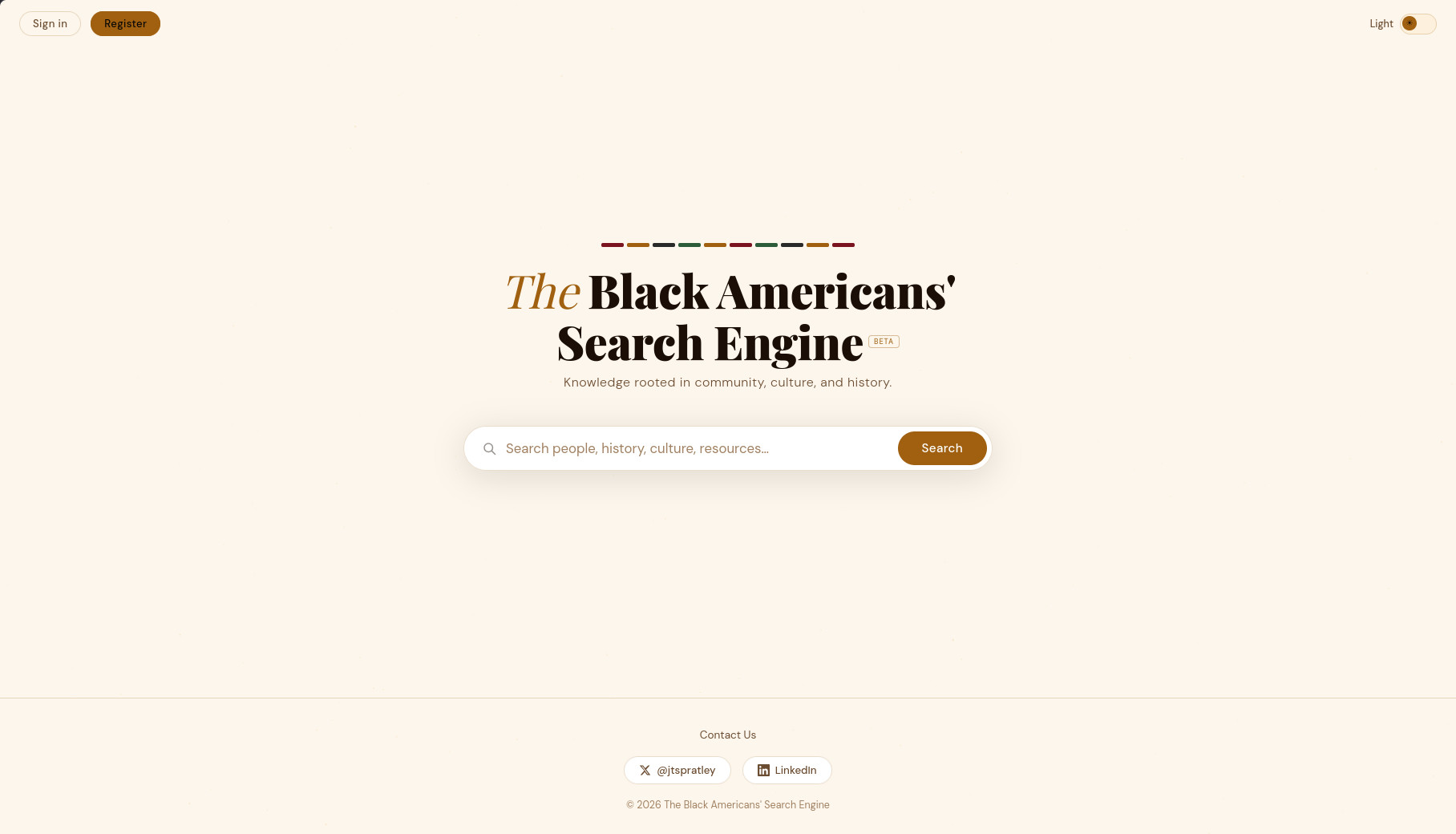
Imagine a search engine that gives you results not only based off of relevancy but community votes. Reddit might come to mind. Unlike Reddit, the Conscious Conscious Baseline – Conscious Black Americans' Search Engine for Lineage Education – for Lineage Education isn't for everybody. One of the first Black-owned search engines per my research, this is for Black Americans serious about building the Black American community, not the African diaspora, "Black and Brown Coalition," or Black and Queer community. Think of Conscious Baseline as the Google Scholar for Black folks serious about Black-centric politics and learning how our lineage.
"Black American" means "American Descendants of Slavery" (ADOS), "descendants of freedmen," Foundational Black American (FBA), etc., not melanated people, "people of color," first generation Black Africans, or Black people from the US "minor outlying islands" (colonies) or elsewhere outside the 50 United States of America.
Conscious Baseline is in its infancy, but I'm serious about this. I'm determined to continue contributing to the solution to the issues affecting Black Americans. Below are deeper reasons I'm building this Black-owned search engine.
Black-Owned Search Engine Makes Black History Research Easier
A few years ago, little content explained the truth behind the 13/50 white supremacist dog whistle. The most prominent links offered mostly shallow information and opinions, rarely backed by reliable sources. That changed when I researched the 13/50 myth and explained actionable steps for Black Americans to weaponize that info today. Now, more Black people know about it. More understand its connection to the:
- School-to-prison labor pipeline
- New Jim Crow book by Michelle Alexander
- 13th Amendment documentary from Netflix
My point is that contextualizing important information in various formats makes the info more accessible. Some might argue the solution is for Black folks to read more books. I agree. But I disagree with lazily trying to shirk accountability to share the knowledge by just telling people "read the book." I have the info. Why not educate others? To not share the knowledge with other Blacks, especially the youth, would be repeating a major sin of our elders today: not passing down adequate knowledge of our community.
This Black American search engine helps connect the dots by reducing noise. When researching Black American history, you must be careful to ensure you're not consuming content just as white-washed and intentionally omissive as what you learned in grade-school. Martin Luther King Jr. is much more than his "I have a dream" speech. Abraham Lincoln's Emancipation Proclamation, signed on September 22, 1862, didn't instantly free Black slaves, nor did he sign it to help Blacks. US chattel slavery evolved to sharecropping and the 13th Amendment. Many sources omit such deeper context intentionally. Why? Because such facts prove that anti-Black racism is still just as prevalent today. They want to preserve a white-washed narrative. My goal is to highlight content that consistently includes that deeper context.
Make Finding Black American-Owned Businesses Easier
There are noticeably more ways to find Black-owned businesses today compared to before the peak of the Black Lives Matter movement:
- Black-owned business directories per city and niche community
- Black business chambers
- Listicles by content creators like myself
- ByBlack's certified Black-Owned Business directory, the first "Black-owned certification" I've found
- Google's "Black-owned" business label
- Search engine AI assistant queries
A few years ago, I visited a business Google had labeled "Black-owned." I was in a rush and didn't do my due diligence. I entered the restaurant and saw nothing but Indian folks. I didn't eat the food. My point: having a curated list of Black American-businesses, knowing the maintainer's definition of "Black-owned," allows you more time to:
- Read reviews for product and customer service quality
- Check products and prices
- Make a decision and live your life
Time is money, and you can't get time back.
Mitigate Shadow Banning and Deplatforming
Shadow banning — decreasing the visibility of content without the creator’s knowledge — is a real thing. YouTube, X (formerly Twitter), and many other sites still do it. I've heard many pro-Black and Black manosphere content creators complain about shadow banning:
- YouTubers live streams not being recommended or notifying current followers
- Randomly losing followers
- YouTube and Twitch streamers' channels being demonetized for saying specific words.
Between the end of the Diversity, Equity, and Inclusion (DEI), which I consider to be a successor of Critical Race Theory (CRT), and Black Americans' reparations being discussed more, I wouldn't be surprised if search engines started demoting or hiding links or websites that mention Black-owned businesses and Black history "they" would rather you not know. This Black-owned search engine provides a fallback solution if that happens in your preferred search engine. Bookmark it just in case — "Search Engine for Black Americans."
Protect Privacy and Fight Online Tracking
I preferred advertising service Project Wonderful (shut down in 2018) over Google Ads because ads shown were based on my preferences, not invasive cross-site trackers. This is the reason I use affiliate marketing links now. You only see ads from companies I personally endorse. I don't want my viewers seeing ads based on what they did on other sites.
Once implemented, instead of placing ads within organic search engine results, they'll be separated so you know what's specific to your query. Then you won't need to wonder where's the most popular result for your search. And I can worry less about you losing trust in my user interface (UI) design. That's a user experience (UX) win for everyone.
Tired of seeing ads? Check out the uBlock Origin or Privacy Badger web browser extension.
Community Votes on Search Results to Negate Misinformation
Community-influenced search results mitigate the effectiveness of "clickbait" — sensationalized headlines, fake AI-generated trailers and other content. In tech circles, these are known as black hat search engine optimization (SEO) tactics. These types of content are usually made by untrustworthy websites known for them. But anyone can be guilty of it, trying to get views. Search engines aren't doing anything about this. In this search engine, your vote matters.
With this search engine, you submit sites you believe should be in the Conscious Black Americans' Search Engine. I review them, and if they benefit Black Americans, I add them. I'm not looking to be a monolith or be the single point of failure, shaping what Black folks think. But I do want to have an idea what the content creator's motives are. I'll have to learn the balance, and you'll have to hold me accountable. You know my name. You have the ability to leave comments in threads. If I slip, hold me accountable.
This is about us, not me. This is about us — Black Americans. "They not like us."
Want to scope out the competition yourself? Here are some other allegedly Black-owned search engines I've found:
- BlackEverything.com looks beautiful and has great features, but I have no idea who runs it.
- Nigerian American-owned HotSaus (formerly HiHat) looks good from the little I've seen (I didn't create an account with them).
- According to itsabouttimebpp.com, BlackWebPortal.com is the first Black-owned search engine. Currently under construction, the domain has been registered since 1999. It was live in the early 2000s according to the Wayback Machine.
Interested? Head over to the Conscious Baseline.
Tags: black-community, black-owned-businesses, black-americans-search-engine, IT, web-development-and-design