


5 Great BOSU Ball Exercises for Balance and Core Stability
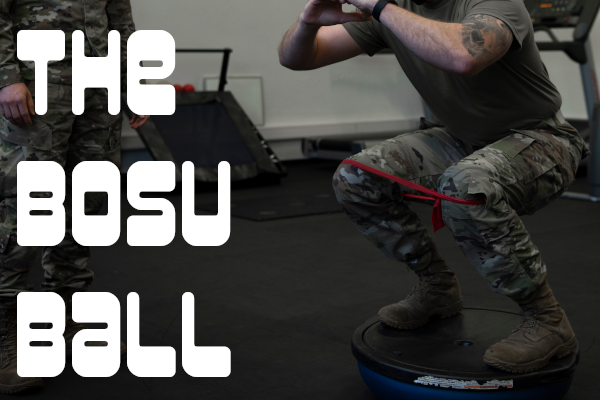
The BOSU Balance Trainer, better known as "BOSU ball," is that big rubber half-sphere that people stand on while exercising. It's usually blue with a black flat side or all black. It may seem like a ridiculous fad, but the BOSU ball is an excellent, advanced tool for improving balance and core stability.
If you're hesitant, there are plenty of options for building up to BOSU ball stability exercises. The single-leg stand is a basic balance exercise that requires no equipment. Tai chi, lesser known than yoga and Pilates, is notable for improving fall prevention. Below I'm going to share some of my favorite BOSU ball exercises.
To mitigate the chance of injury, ensure you're able to do every exercise below without a BOSU ball first.
Note that shaking the first few times you do a BOSU ball exercise is normal. It's simply your muscles learning to respond faster to stabilize you better. Don't be too surprised if you shake less even after 1-2 BOSU Ball workouts.
BOSU Ball Crunch
Doing the crunch on a BOSU ball has multiple benefits:
- Simple introductory exercise to the instability
- Allows you to comfortably hyper-extend your back for more range of motion
- Therefore, reduces the urge to pull on your neck to force more range of motion
- Works the obliques more than compared to regular crunches
Just be sure to keep the hips down. You'll likely need far fewer reps to feel this one.
Aim for 3 sets of 10 reps with 1–2 minutes of rest in between.
BOSU Ball Plank
The BOSU ball plank challenges core stability more while keeping you low to the floor for safety. Like regular planks, there are many ways to make the BOSU ball plank more or less difficult. I recommend starting with these two variations based on your skill level.
Start off kneeling, BOSU ball squishy side up. Then progress to knees up, legs straight.
Then progress to the top of a push-up position, flat side of the BOSU ball up.
Try to hold for 3 sets of 10 seconds each with 30–60 seconds of rest.
Standing BOSU Ball Exercises
For standing movements, be close to something you can hold to balance yourself while you get used to the instability.
BOSU ball ankle stability exercises start with standing on it. This is an advanced fall prevention exercise. Be close to something you can grip for reassurance. How you get on it is your choice. I prefer stepping on one side, then stepping on the opposite side to shift weight to the center, like a skateboard. Some prefer standing on the center with both feet before shimmying out. The videos below show each option.
My preference:
Alternative option:
However you get on the BOSU ball, ensure your feet are evenly spaced and centered. Once you get comfortable standing on the BOSU ball, you can do a lot of standing exercises to further challenge your balance. There's also the one-leg BOSU ball stand. A natural progression for the BOSU ball stand...
Try 3 sets of 10–20 second stands with 1 minute of rest.
BOSU Ball Squat Variations
Squats on a BOSU ball force all lower body and deep core muscles to stabilize you throughout the movement. They also double as BOSU ball ankle stability exercises to mitigate sport-related injuries. Take your time during the squat movements. And remember, the legs wobbling means the muscles are learning to better stabilize you.
Start with 2–3 sets of 5–10 reps and 1–2 minutes of rest.
BOSU Ball Medicine Ball Wood-chop
The BOSU ball wood-chop is the most difficult BOSU Ball stability exercise on this list for good reason. First, understand the medicine ball wood-chop exercise without the BOSU ball. It's on this list because it works the core muscles — abs, obliques, and lower back — as well as the shoulders and upper-back muscles. The movement is close to what you'd imagine:
- Stand with slightly bent knees and a weighted object on one side of your hips
- With straight arms (elbows not locked) move the object overhead on the opposite side of your body
- Return to the start position and repeat for ~10 reps
- Repeat the exercise from the opposite side of your waist
Doing wood-chops on a BOSU ball is more difficult compared to BOSU squats for a few reasons:
- You're moving the weight in and out of your base of support (feet stance)
- Because of the overhead movement, your shoulders work harder to move the weight
- If you add a squat when lowering the weight, it is a full-body, multi-joint stability exercise
Slowly work up to 2–3 sets of 5–10 reps and 2–3 minutes of rest, mostly for the shoulders.
BOSU stability ball exercises don't just add variety to your workout. They improve balance and joint stability to mitigate the chance of injury. Those benefits apply to everyone, regardless of your age.
Want to learn more about exercising to improve quality-of-life? Check out this guide on reducing chronic back pain. Want a workout plan specific to your goals? Read my personal trainer page.